Real Training Data from over 1,200+ Northern California Students
Overview
This report presents real-world training data from over 1,000+ CCW students trained between 2023 and 2026 across the San Francisco Bay Area, including Contra Costa, Alameda, Solano, Marin, and Napa counties.
All data is based on first-hand instruction, live-fire qualification results, and direct observation during training—not surveys or third-party estimates.
This dataset reflects how civilian CCW applicants actually perform when handling and qualifying with their firearms.
Key Findings
- Most CCW applicants in the Bay Area are first-time gun owners with little to no prior training.
- The #1 observed deficiency is unsafe or inconsistent firearm handling, especially during draw and reholstering.
- Students improve most during live-fire training with instructor feedback, not classroom-only instruction.
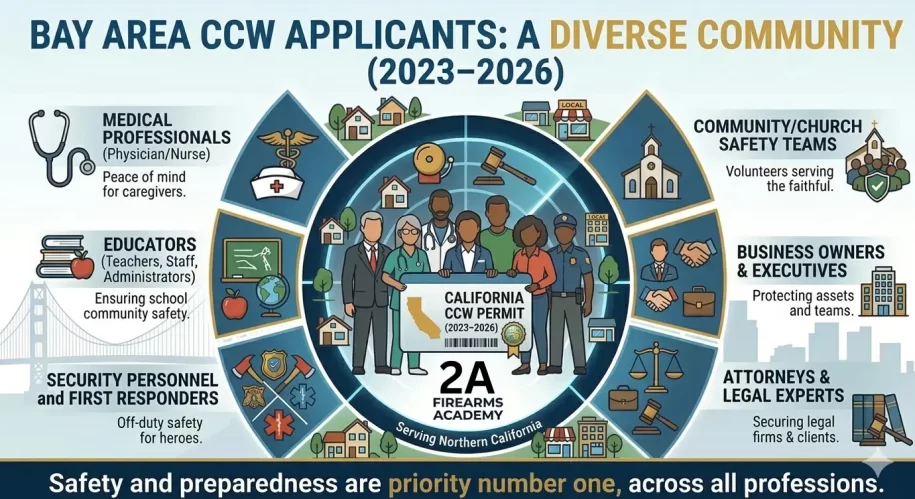
- A growing number of applicants are professionals, including doctors, attorneys, business owners, and first responders.
- Many students report that prior training (especially renewals) lacked hands-on instruction and real evaluation.
- Safe gun handling and decision-making under pressure are more important than basic marksmanship alone.
Market Shift: CCW Demand After New York State Rifle & Pistol Association v. Bruen
Following the 2022 Supreme Court decision, CCW applications increased significantly across California.
Observed trends include:
- Increased demand for initial CCW training
- Growth in renewal applicants returning for updated training
- Higher volume of first-time firearm owners entering the process
This aligns with broader statewide reporting showing a sharp rise in permit applications and processing demand.
Who Is Taking CCW Classes in the Bay Area
Based on observed student data, the typical CCW applicant today is not an experienced shooter.
Common demographics include:
- First-time gun owners
- Working professionals (medical, legal, business)
- Security personnel and first responders
- Individuals with no prior formal firearms training
Many students enter training with:
- Minimal understanding of firearm safety
- Limited or no live-fire experience
- Uncertainty about legal use-of-force standards

What Students Struggle With Most
Across all counties and experience levels, the same issues consistently appear.
Primary deficiencies:
- Safe Firearm Handling
- Muzzle discipline
- Trigger finger placement
- Safe loading and unloading
- Draw and Reholstering
- Unsafe draw mechanics
- Lack of control during reholstering
- Poor holster familiarity
- Decision-Making Under Pressure
- When to shoot vs. when not to
- Understanding use-of-force boundaries
- Lack of situational awareness
- Inconsistent Fundamentals
- Grip and recoil control
- Sight alignment under time pressure
- Follow-up shot discipline

Where Students Improve Most
The most measurable improvement happens during:
Live-Fire Training with Instructor Feedback
Students show the fastest progress when:
- Instructors actively correct unsafe behavior
- Training includes repetition under supervision
- Students use their actual carry firearm and holster
- Drills simulate realistic defensive scenarios
Classroom instruction alone does not produce the same level of improvement.

Training vs. Qualification: A Critical Gap
A consistent issue observed across many students:
Passing a qualification course does not always mean the student is safe or prepared.
Some students report prior courses where:
- No live-fire diagnostics were conducted
- Minimal correction was given during shooting
- No holster work was included
- Alternative tools (non-firearm simulators) were used
This creates a gap between:
- Meeting minimum requirements
- Demonstrating real-world competency

Regional Training Patterns
While students come from across the Bay Area, training demand is concentrated in:
Many applicants travel outside their home city to find:
- Available training slots
- Approved instructors
- Courses that meet issuing agency requirements
Frequently Asked Questions
What do people struggle with most in CCW training?
Most students struggle with safe firearm handling, especially during draw and reholstering. Decision-making under pressure is also a major challenge.
Are most CCW applicants experienced shooters?
No. Most applicants are first-time gun owners with little or no prior formal training.
Is CCW training difficult to pass?
Most students can pass with proper instruction, but many initially lack the skills needed for safe and consistent firearm handling.
What matters more: accuracy or safety?
Safety and proper handling matter more than accuracy alone. Unsafe gun handling is the most common issue observed in training.
Do students improve during training?
Yes. The most significant improvement happens during live-fire training with direct instructor feedback and repetition.
Data Interpretation
This report reflects direct, observed performance from over 1,000+ students and is intended to provide insight into:
- Real training outcomes
- Common deficiencies
- How students improve over time
It does not represent statewide totals or government-issued statistics but aligns with broader trends observed across California.
Related Training Resources
For more information on CCW training, firearm safety, and legal use-of-force, see:
- California CCW Training Courses
- Use-of-Force and Self-Defense Education
- Issuing Authority References and Approved Instructor Listings
Disclaimer
This report is based on firsthand training data and observations from 2A Firearms Academy. It is intended for informational and educational purposes only and does not constitute legal advice.