
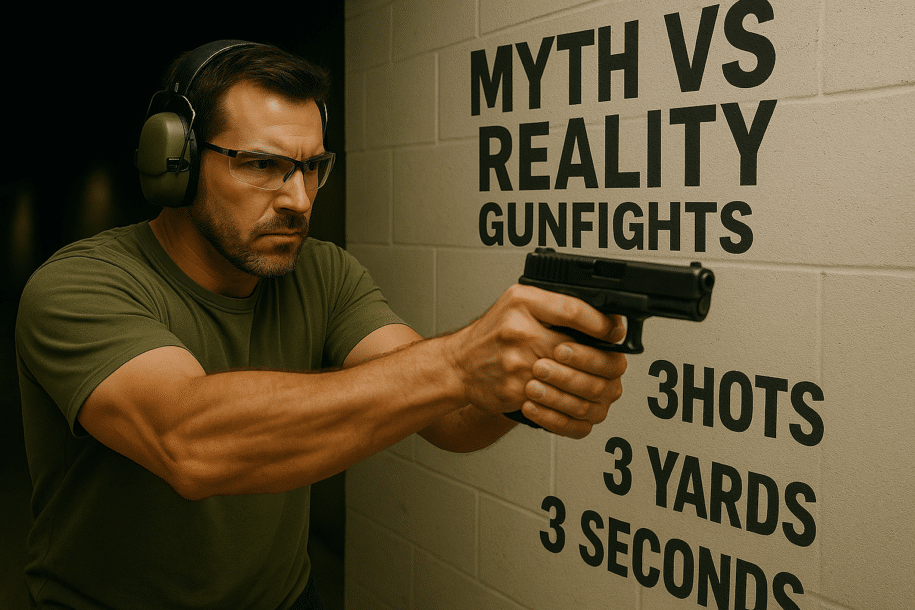
The Death of the “3–3–3” Myth: What Real Defensive Gunfights Actually Look Like
For decades, one of the most repeated sayings in defensive firearms circles has been the tidy little mantra: “Three yards, three shots, three seconds.” It’s recited in classrooms, quoted on forums, and used to justify minimal training standards. The idea is simple: most gunfights are quick, close, and over almost instantly—so why bother mastering anything beyond the basics?
There’s just one problem.
It isn’t true.
Not in any meaningful way. Not for private citizens. Not according to real-world data.
And the longer we cling to this oversimplification, the more we handicap ordinary people who may someday have to defend their lives.
Where the Myth Comes From — And Why It’s Wrong
Ask someone where the “3–3–3” statistic originated and they’ll usually shrug and say, “The FBI.” But the FBI has never published such a claim, and the Bureau itself has dismissed the idea when asked. Some point to the LEOKA (Law Enforcement Officers Killed and Assaulted) report, but even that doesn’t support the narrative—it only documents officers killed, not the full scope of police gunfights, and police encounters are fundamentally different from civilian defensive shootings.
So the myth survives not because it’s factual, but because it’s convenient.
It’s an appealing shortcut.
It reassures the untrained.
It excuses poor marksmanship and minimal practice.
Unfortunately, reality is far more complex—and far more demanding.
What Real Defensive Encounters Show: A Year of Data
An analysis of 66 private-citizen defensive gun uses—captured on video across 2025—paints a very different picture. It’s not a scientific sample of every incident nationwide, but it reflects thousands of gunfights studied over more than a decade. And the trends are unmistakable.
1. Most gunfights require more than three rounds
55% involved more than three shots
23% exceeded the capacity of a 5-shot revolver
A meaningful percentage involved 7–10+ rounds
The takeaway:
A revolver can work in trained hands—expert hands—but capacity matters more than many want to admit.
2. Distance is far greater than the myth claims
Here’s the real breakdown of distances where defenders fired shots:
32% occurred between 3–7 yards
29% occurred between 7–10 yards
18% occurred between 10–15 yards
6% occurred beyond 15 yards
Only 18% were at 3 yards or less
That means:
Over half of documented defensive gunfights required accurate shots beyond 7 yards.
And about one in four stretched beyond 10 yards.
This is the opposite of the “you’ll never need to shoot past 7 yards” advice that often circulates in casual gun culture.
3. Entanglement is real — but not what Hollywood shows
About 12% of incidents involved hands-on contact at some point between defender and attacker.
But interestingly:
0% required contact shots pressed into the attacker’s body
This reinforces the importance of learning close-quarters retention, movement, and defensive tactics—but it does not suggest that contact shots are the norm.
4. Reloads almost never matter
In private citizen gunfights, reloads simply don’t occur in time to matter.
Not once in these 66 cases did a reload affect the outcome.
When they happened at all, they were post-fight administrative reloads.
The fight is won with what is already in your gun.
What This Means for the Everyday Armed Citizen
The practical implications are huge, and they challenge assumptions many gun owners take for granted.
1. Capacity matters more than convenience
A 5-shot revolver demands expert performance:
flawless marksmanship, airtight decision-making, and perfect threat identification.
Most people—despite good intentions—are not at that level.
Micro-9s, compacts, and modern carry pistols offer more capacity without meaningful sacrifice. When up to 20% of gunfights require more than 5 rounds, the choice becomes clearer.
2. You need to be able to shoot well past 7 yards
If more than 50% of real defensive shootings require accuracy past 7 yards, training should reflect that.
If 25% go beyond 10 yards, precision becomes even more important.
This isn’t fantasy.
It’s what real people end up needing to survive.
3. Pistol-mounted optics aren’t a trend—they’re a tool
Red dots don’t slow you down up close.
But at distance, especially under stress, they offer a measurable advantage:
Faster visual confirmation
Tighter groups
Clearer aiming point for aging eyes
Improved performance at 10–40 yards
In a world where realistic defensive distances stretch into double-digits, PMOs are not gimmicks—they’re smart.
4. The real fight isn’t “3 seconds and done”
Gunfights are often messy, dynamic, and unpredictable.
They involve movement, surprise, angles, concealment, entanglement, and rapidly shifting threats.
Training must move beyond:
Stand-and-deliver drills
Static accuracy at 3–5 yards
Slow qualifications with generous scoring zones
Instead, armed citizens need:
Distance shooting capability
Movement and positional shooting
Weapon retention and entangled-fight skills
Decision-making under stress
A realistic understanding of timing, distance, and probability
The Real Story: “Be Better”
The myth of the “3–3–3 gunfight” has stuck around because it comforts people.
It suggests you don’t need much training.
It suggests you don’t need to practice regularly.
It suggests the bare minimum is enough.
But the truth tells a different story:
More rounds
More distance
More skill required
If anything, the modern defensive encounter requires a higher standard of competence than ever before.
The phrase that replaces the myth isn’t as catchy, but it’s far more honest:
Expect farther
Expect more
Train accordingly
Because when it comes to a real defensive encounter, the gunfight you get won’t care about the myth you believed.