Choosing a firearms instructor for California Concealed Carry Weapon (CCW) training is not just about class quality or convenience. It is about ensuring that the training you complete will actually be accepted by the issuing authority handling your application.
Not all CCW training is accepted by every agency. Applicants who enroll without verifying instructor acceptance may experience delays, rejected certificates, or be required to take another class at additional cost.
This guide explains how CCW applicants can independently research and verify an instructor before enrolling, using publicly available information and clear due-diligence steps.
Why Instructor Verification Matters
In California, CCW permits are issued by either a county sheriff’s office or a city police department. Each issuing authority sets its own requirements for accepting CCW training.
Acceptance may be based on:
appearance on an agency-maintained instructor or provider list, or
the instructor holding specific state-required credentials
A course accepted by one agency may not be accepted by another, even within the same county. Applicants are responsible for confirming that their chosen instructor meets the requirements of the specific agency issuing their permit.
The Two CCW Training Acceptance Models
Issuing authorities generally follow one of two models when evaluating CCW training.
Understanding which model applies is the first step in researching an instructor.
List-Based Acceptance Model
Some issuing authorities publish an official list of accepted CCW instructors or training providers. These lists may appear as:
public web pages
PDF documents
instructor or vendor lists provided during the application process
When an agency maintains a list:
only instructors or providers on that list are accepted
holding a DOJ certification or Certificate of Eligibility does not override the list
training from an unlisted instructor will generally not be accepted
If an instructor is not listed, applicants may be required to complete another CCW course with an accepted provider.
Credential-Based Acceptance Model
Other issuing authorities do not maintain public instructor lists. Instead, they accept CCW training from any instructor who meets statutory and regulatory requirements.
In these jurisdictions, acceptance is based on instructor credentials rather than appearance on a list.
How to Research a CCW Instructor Before Enrolling
Once you understand which acceptance model applies, use the steps below to research an instructor responsibly.
Step 1: Identify Your Issuing Authority
Before researching an instructor, confirm which agency will issue your CCW permit. This is typically:
a county sheriff’s office, or
a city police department (for cities that issue permits directly)
Always research instructor acceptance based on the issuing authority name, not just the county.
Step 2: Check for an Official Instructor or Provider List
If your issuing authority publishes a list:
locate the list on the official agency website or document
confirm the instructor or training organization appears by name
ensure the list is current
If the instructor does not appear on the list, the training will generally not be accepted, regardless of verbal assurances.
Step 3: Verify Instructor Credentials (Credential-Based Agencies)
If the issuing authority does not maintain a list, applicants should verify that the instructor holds required credentials.
Commonly required credentials include:
Certificate of Eligibility (COE)
A valid COE is issued by the California Department of Justice and confirms the instructor has passed a background check and is eligible to work in firearms-related instruction.
Applicants should confirm that the COE is current.
DOJ CCW Instructor Certification
This certification authorizes an instructor to conduct CCW training that meets California DOJ standards.
Applicants should verify that the certification:
is current
applies specifically to CCW instruction
Step 4: Confirm Course Scope and Documentation
Even when an instructor is properly listed or credentialed, applicants should confirm that the course meets issuing-authority requirements, including:
required training hours
live-fire qualification standards
certificate format and documentation
Instructors should be able to clearly explain how their course aligns with common issuing-authority expectations.
Red Flags to Watch For When Choosing a CCW Instructor
The following red flags commonly result in training being rejected and applicants having to retake a CCW course.
Red Flag: Assuming County and City Agencies Use the Same Acceptance Rules
County sheriffs and city police departments are separate issuing authorities, even when operating within the same county.
For example:
Napa County Sheriff’s Office
Napa Police Department
These agencies do not necessarily share instructor lists or acceptance criteria. Training accepted by one may not be accepted by the other.
Applicants must verify acceptance for the exact agency issuing their permit.
Red Flag: Relying on an Instructor’s Verbal Assurance
Statements such as:
“We’re accepted everywhere in the county”
“We’ve never had a problem before”
“Other students used us for that agency”
should not replace verification.
If an issuing authority maintains a published list and the instructor is not on it, the training will generally not be accepted, even if the instructor is DOJ certified and holds a COE.
Red Flag: Treating List-Based and Credential-Based Agencies the Same
Credential-based acceptance applies only where the issuing authority has adopted that model.
If an agency publishes a list:
the list governs acceptance
credentials alone are insufficient
Applicants should not assume credential-based acceptance applies universally.
Red Flag: Unclear or Evasive Answers About Acceptance
Instructors should be able to clearly explain:
whether they appear on relevant agency lists
whether they hold a current COE
whether they hold DOJ CCW Instructor Certification
Evasive or unclear answers are a warning sign.
Decision Flow: How to Evaluate a CCW Instructor
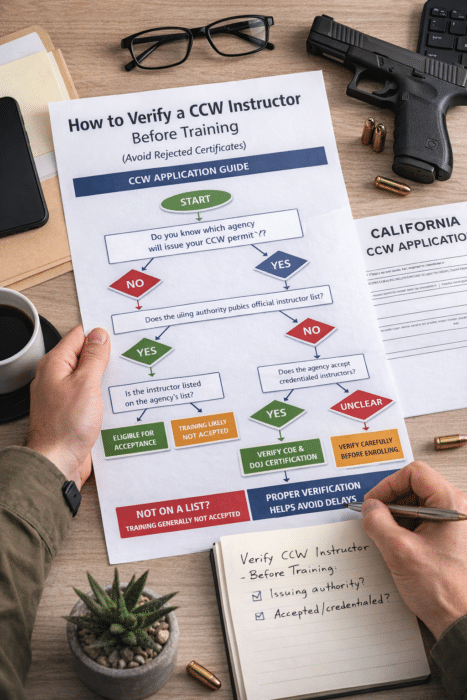
Use the following logic when researching an instructor:
Identify the issuing authority for your application
Determine whether the agency publishes an instructor list
If a list exists, confirm the instructor appears on it
If no list exists, verify instructor credentials
Confirm the course meets training and documentation requirements
If an agency maintains a list and the instructor is not on it, the training will likely not be accepted.
Bottom Line for CCW Applicants
Before enrolling in CCW training, always confirm:
which agency is issuing your permit
whether that agency uses a list-based or credential-based acceptance model
whether the instructor appears on the agency’s list, if one exists
whether the instructor holds required credentials where applicable
If an issuing authority maintains a published list and the instructor is not included, the training will generally not be accepted, and applicants may be required to complete another course.
Why This Guide Exists
This guide is provided to help CCW applicants make informed decisions using publicly available information and verifiable instructor credentials—not marketing claims.
Doing proper due diligence before enrolling helps ensure:
your training is accepted
your application proceeds without delay
you complete the process correctly the first time